September 3, 2015
“At Boston MedFlight, we’ve valued the benefits of simulation training for many years. Our pilots and medical staff are involved in separate simulator environments that put them in real world scenarios, challenging their critical thinking skills. The benefits of this level of training are evident in our everyday operation. We push our staff to the very edge because no one gets hurt in a simulator,” said Charles Blathras, Chief Operations Manager for Boston MedFlight.
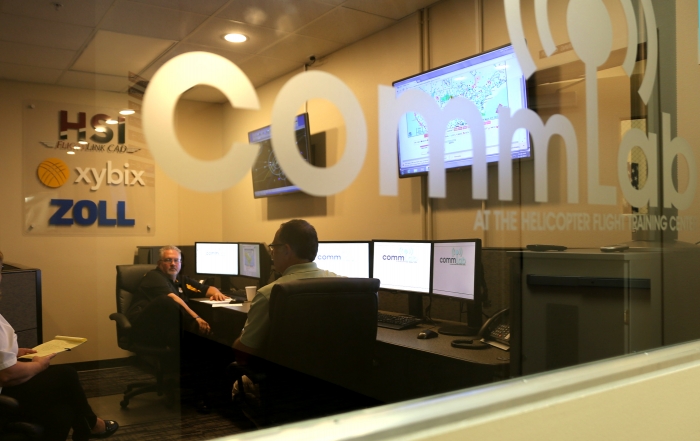
Originally created to rapidly transport patients with life threatening illnesses or injuries to the proper facility, Boston MedFlight has evolved into a critical care transport system for the North East region. The crew completes an average of 5 helicopter flights per day, and more than 1,600 ground transports annually. With a large transport volume comes the requirement for a highly specialized training team to ensure the highest level of patient care. Blathras recently visited the CommLab at the Helicopter Flight Training Center (HFTC) with his Communications Supervisor, and said his experience was one-of-a-kind.
“While we’ve explored utilizing simulator training for our communications specialists in the past, we just didn’t have all the pieces. The CommLab offers a state-of-the-art facility with the actual CAD system utilized by your program,” he said. “Instructors that include industry leaders in Communications Centers of well-established transport programs provide guidance and an innovative experience for these professionals.”
The CommLab is a partnership between Flight Vector, Golden Hour, HSI, Xybix and Zoll. Training scenarios take comm specs through a variety of situations to prepare them for the strenuous job they face on a daily basis. While in the CommLab, specialists are able to communicate with pilots training down the hall in one of the HFTC’s flight simulators.
“The opportunity to simulate a scenario, jointly, with pilots in the flight simulator and their communicators in the Comm Center is truly a revolutionary idea,” said Blathras. “We can develop a variety of formats to focus on different aspects of their responsibilities including customer service scenarios, a routine day, or even managing a catastrophic event. The potential for this venue is endless and finally gives this group of individuals a robust training experience.”
Stay Updated with Metro
Metro Delivers Tech-Forward Airbus H125 to Texas DPS
Metro Tech-Forward Airbus H125 to Texas Department of Public Safety June 23, 2026 Metro Aviation has officially completed and delivered a highly customized, mission-ready Airbus H125 to the Texas Department of Public Safety (TXDPS) Aircraft Operations Division. Built...
Metro Aviation Advances H160 EMS Interior STC Development
Metro Aviation Advances H160 EMS Interior STC Development MARCH 11, 2026 Metro Aviation continues development of its Supplemental Type Certificate (STC) for the Airbus H160, marking another step forward in bringing next-generation air medical capabilities to...
Metro Aviation Attends Verticon 2026
METRO ATTENDS VERTICON MARCH 10, 2026 Metro Aviation will highlight several aircraft and key partnerships at VERTICON 2026 in Atlanta, including an EC145 C2 and the AW09 aircraft on display at the Metro booth, and multiple completed aircraft featured on the Airbus...
Download Brochure
Metro Aviation is constantly growing our capabilities and expanding our reach. Metro holds more than 30 Supplemental type Certificates (STC) and completes about 35 aircraft each year for U.S. customers anf global clients.

After Hours Part Support (318) 455-5204